This past semester in English 1102, I may have picked up a
few tricks and learned a couple lessons for myself as a writer, student, and
character through life. One main thing, however, that I really learned is that
I am not a writer without a purpose, or rather, no one is a writer without a
purpose. Every writing has purpose, whether it’s to entertain, inform,
instigate, or to argue. My purpose, I realized, is that my purpose concerning
writing is to express my thoughts and concerns through creative writing in
order to inform my audience and to instigate actions through them. If I am
gifted with the power to feed, should I not feed the hungry? If I am gifted
with the power to comfort, should I not console the hurt? I have improved my
skills as a writer by understanding that my sole purpose for writing isn’t to
earn an acceptable grade, but rather create purpose in others. This discovery
in purposeful writing was inspired by the assignment of finding my own social
justice issue topic, wherein I was required to pick an issue, research and
describe it in my own words, construct solutions based on that issue, and
present my findings in my own manner. All of the different obstacles that stood in my way (writer's block, research-intensive sessions, etc.) have only built my character and personality as a writer, and each stumbling block I've overcome have been used as a building block for my life ahead of me, as a student, writer, and missionary. English 1102 may not have dramatically changed my life, but even a tiny pebble can create ripples in the biggest of oceans.
Monday, May 2, 2016

Friday, March 18, 2016
My Extraordinary Ellijay Experience
Growing up, I took for granted the gifts that God had graciously given me: my parents, my friends, my church leaders, my clothes, my education, my food... I could go on forever.
But one of the most important and special things I took for granted was my church family.
On December, 2010, I started visiting the Atlanta Korean SDA Church, and I was introduced to a group of people that were talkative, rambunctious, crazy, and much, much, more. From the outside, they were just another group of kids that I could socialize with, and then forget for the other six days of the week. Little did I know, I found a family that would accept me and love me for who I am, and I wouldn't abandon them for the world.
On March 12, 2016, I ventured with my Adventist brothers and sisters to Ellijay, Georgia for a weekend-long retreat just for the youth group, a.k.a, my family. We prayed together and for each other, we sang songs of praise together, and we ate scrumptious food together (s'mores, s'mores, and some-mores). At one point during the day, we all reluctantly hiked to a waterfall (which felt like an eternity) where we took plenty of pictures and splashed around in the icy cold water (I know it was icy cold because I slipped and fell into the water while everyone laughed). We learned about the faith we need to fight our Goliaths, the hope we need to keep until Jesus comes back, and the love we need to uplift each other in times of distress. I made some new friends, and dare I say we adopted a few more people into our big, happy family.
In Matthew 12:49-50, Jesus says, " 'Here are my mother and my brothers! For whoever does the will of my Father in heaven is my brother and sister and mother.' " Up until this past retreat, I gradually forgot what a family truly meant.
But now I remember.
But one of the most important and special things I took for granted was my church family.
On December, 2010, I started visiting the Atlanta Korean SDA Church, and I was introduced to a group of people that were talkative, rambunctious, crazy, and much, much, more. From the outside, they were just another group of kids that I could socialize with, and then forget for the other six days of the week. Little did I know, I found a family that would accept me and love me for who I am, and I wouldn't abandon them for the world.
On March 12, 2016, I ventured with my Adventist brothers and sisters to Ellijay, Georgia for a weekend-long retreat just for the youth group, a.k.a, my family. We prayed together and for each other, we sang songs of praise together, and we ate scrumptious food together (s'mores, s'mores, and some-mores). At one point during the day, we all reluctantly hiked to a waterfall (which felt like an eternity) where we took plenty of pictures and splashed around in the icy cold water (I know it was icy cold because I slipped and fell into the water while everyone laughed). We learned about the faith we need to fight our Goliaths, the hope we need to keep until Jesus comes back, and the love we need to uplift each other in times of distress. I made some new friends, and dare I say we adopted a few more people into our big, happy family.
In Matthew 12:49-50, Jesus says, " 'Here are my mother and my brothers! For whoever does the will of my Father in heaven is my brother and sister and mother.' " Up until this past retreat, I gradually forgot what a family truly meant.
But now I remember.
Tuesday, March 1, 2016
The Story of Joseph Kim: Rhetorically Analyzed
The best storytellers don't gain their audience's attention from just a good story, but rather through the circumstances in which the story is being told. Joseph Kim, a refugee from North Korea and victim to the country's tyrannical regime, tells his story of hard work, hunger, and hope at the TEDGlobal 2013 Convention. Through Joseph Kim overcoming his struggles of not only the oppression of North Korea, but also the struggles of being a stranger in a foreign land, his proper usage of ethos, pathos, and logos efficiently engages his audience into finding within themselves the hope they need to survive and overcome daily and lifelong struggles.
Joseph Kim, a North Korean man who has escaped his motherland for a new life in the United States, proves his excellent use of ethos by sharing his testimony. Any man, woman, or child can claim that they are from North Korea, but in Joseph Kim's eyes, one can see the struggles, battles, and experiences that he has endured, regardless if they are from that country or not. Although he doesn't presently possess the proper documentation or any official records that state his personal information, such as a birth certificate, the majority of his testimonies and stories can be proved by his rescuers and family. Believing Joseph Kim's credibility is easy because his presentation gives the idea that he genuinely suffer as he testifies he did.
Explaining his difficulties and battles, physical and emotional, Joseph Kim's words cut deep by the usage of pathos. Although I may have gone through a breakup in the past, Joseph Kim admits that he has had nights where hunger or the bitter cold kept him from sleeping. I can't say I have felt the same, but my heart goes out to him because I can't fully comprehend and understand exactly what it feels like to be so distracted by hunger pangs that I am unable to sleep. There were days when I worked a seven hour shift during major holidays. There were days when he worked in a coal mine during the harsh winter for up to sixteen hours a day just for food and nothing more. My heart breaks for him, and my heart breaks for those who have, and are currently, going through the similar struggles, and I believe that my heart breaks because of Joseph Kim's powerful use of pathos.
Because of the nature of the TED Talk, logic seems to dwindle in Joseph Kim's story. The element of logos seems less emphasized simply due to the story being an autobiography rather than an infomercial about toothpaste. There are moments, however, when Joseph Kim explains his circumstances in a much more logical approach. For example, he states that his family especially struggled during the Great Famine of 1994 in North Korea, and later he says that others with similar stories worked up to sixteen hours a day inside coal mines during the bitter winter just for scraps of food. Towards his conclusion, however, Joseph Kim reasons that the only thing that we as human beings can do for others is to show love and express hope to those around us, because the only things that kept him alive were the small acts of love from his rescuers and foster parents, and the hope he discovered during his struggles. Although he may be attempting to gather sympathy from the audience, Joseph Kim does an appropriate job of implementing logos.
Through the various usages of the elements of pathos, logos, and ethos, Joseph Kim efficiently convinces and persuades the audience into understanding his message and mission. Hope and love are the weapons we can use against the North Korean regime, and hope and love are the comforts we can give each other to lift each other up, rather than push each other down. This very message makes its home in the audience's hearts due to Joseph Kim's implementation of the elements of pathos, logos, and ethos.
If you want to see the TED Talk given by Joseph Kim, you can watch it here.
***
Works Cited:
Kim, Joseph. "The Family I Lost in North Korea. And the Family I Gained."
TED, June 2013. Lecture.
Friday, February 26, 2016
The North Korean Conditions
Every morning, I have food to eat. Every morning, I have water to drink. Every morning, I have clothes to wear. In this world, I am expected to live until I'm eighty, ninety, or even to a hundred years old, yet the reality that there is an entire nation that live entirely opposite, short lives shocks me. It shocks the world, if they are compassionate enough to open their eyes. The North Korean people, the people who have been forcibly dragged and born into their poor country, these are the ones whose realities are those that are the conflicts and plots of Hollywood movies. We can watch these movies because a small part of ourselves know that the characters are fiction, and we know that the conditions displayed before our very eyes cannot be in the slightest true.
But why can I hear their cries of pain and sadness around me?
Hazel Smith, the author of the scholarly article CRIMES AGAINST HUMANITY?, explains that we know "much less about the status of civil and political rights" (132), meaning that the world knows very little about the level, or degree, of rights that belong to the people of North Korea. Concerning health, food, and nutrition, however, Smith argues that, thanks to the United Nations agencies that work in the Democratic People's Republic of Korea, there have been "over four-and-a-half thousand reports on aspects of DPRK society" (133). The world can finally have a look into the well-being of the North Korean people; however, this does not automatically assume that the people are all healthy and are eating nutritious meals. In fact, a report given by Special Rapporteur Marzuki Darusman to the UN Human Rights Council states the complete opposite. Smith quotes Darusman by saying that the "Annex to the report makes the factual claim that the health and nutrition status of the population is exceptionally poor" (134). Every morning, I have food to eat. Every morning, I have water to drink. But every morning, these people have nothing.
Within the confines of what the UN knows officially (documents, reports, analyses, etc.), there may not be many violations of human rights in the Democratic People's Republic of Korea. The regime keeps a very tight leash on that information; in fact, they lie to the world about the conditions within their borders. But, why? A boy only keeps the fact that he stole twenty dollars from his mother a secret because he fears two things: he knows something is wrong, and he knows if his mother finds out, he will be punished. In this case, the Kim Dynasty knows very well that they are doing something very, very wrong. The Kim Dynasty also knows very well that if the world knows officially that they have stripped their people of their rights, then their crimes will not go unpunished.
Refugees such as Joseph Kim, Hyeon-seo Lee, and Dong-hyuk Shin all have shared their stories concerning the conditions of North Korea, along with many others rescued by a non-profit, non-government organization, Liberty in North Korea, who seek to rescue those who have escaped North Korea into China's borders. Shin, author of the famous book Camp 14, writes about his time in North Korean concentration camp Camp 14. He explains that he had spent his entire life up to his escape in the camp being tortured and beaten. Catherine E. Shoichet and Madison Park, authors on CNN, co-wrote an article that focused on the refugee's inaccuracies about his time in North Korea. While I may find the argument that his testimony is invalid now, his admittances are still inhumane and cruel concerning the treatment he received from the North Koreans. In Camp 18, a concentration camp, Shin says that that's where "he witnessed authorities execute his mother and brother" (Shoichet and Park). Also, he explains that instead of his finger being chopped off by one of the prison guards, it was actually "mangled as a guard pulled out his fingernails as a punishment for escaping" (Shoichet and Park). The cruelty and monstrosity of the North Korean government remain as inhumane as his book states, as well as the testimonies of every other North Korean refugee.
The conditions of North Korea may be politically average or mediocre, but the people of the North Korean totalitarian state have voiced their stories. Although they may come from different backgrounds, such as a higher class, a lower class, in prison, or as a child born from sex trafficking, there remains one common pattern: North Korea is a country that has stripped the rights of its people, make them suffer, and have lied continuously to the world about their wrongdoings.
We must stand up.
We must fight.
***
Works Cited:
1. Shoichet, Catherine E., and Madison Park. "North Korean Prison Camp Survivor
Changes Story." CNN. Cable News Network, 20 Jan. 2015. Web. 26 Feb. 2016.
But why can I hear their cries of pain and sadness around me?
Hazel Smith, the author of the scholarly article CRIMES AGAINST HUMANITY?, explains that we know "much less about the status of civil and political rights" (132), meaning that the world knows very little about the level, or degree, of rights that belong to the people of North Korea. Concerning health, food, and nutrition, however, Smith argues that, thanks to the United Nations agencies that work in the Democratic People's Republic of Korea, there have been "over four-and-a-half thousand reports on aspects of DPRK society" (133). The world can finally have a look into the well-being of the North Korean people; however, this does not automatically assume that the people are all healthy and are eating nutritious meals. In fact, a report given by Special Rapporteur Marzuki Darusman to the UN Human Rights Council states the complete opposite. Smith quotes Darusman by saying that the "Annex to the report makes the factual claim that the health and nutrition status of the population is exceptionally poor" (134). Every morning, I have food to eat. Every morning, I have water to drink. But every morning, these people have nothing.
Within the confines of what the UN knows officially (documents, reports, analyses, etc.), there may not be many violations of human rights in the Democratic People's Republic of Korea. The regime keeps a very tight leash on that information; in fact, they lie to the world about the conditions within their borders. But, why? A boy only keeps the fact that he stole twenty dollars from his mother a secret because he fears two things: he knows something is wrong, and he knows if his mother finds out, he will be punished. In this case, the Kim Dynasty knows very well that they are doing something very, very wrong. The Kim Dynasty also knows very well that if the world knows officially that they have stripped their people of their rights, then their crimes will not go unpunished.
Refugees such as Joseph Kim, Hyeon-seo Lee, and Dong-hyuk Shin all have shared their stories concerning the conditions of North Korea, along with many others rescued by a non-profit, non-government organization, Liberty in North Korea, who seek to rescue those who have escaped North Korea into China's borders. Shin, author of the famous book Camp 14, writes about his time in North Korean concentration camp Camp 14. He explains that he had spent his entire life up to his escape in the camp being tortured and beaten. Catherine E. Shoichet and Madison Park, authors on CNN, co-wrote an article that focused on the refugee's inaccuracies about his time in North Korea. While I may find the argument that his testimony is invalid now, his admittances are still inhumane and cruel concerning the treatment he received from the North Koreans. In Camp 18, a concentration camp, Shin says that that's where "he witnessed authorities execute his mother and brother" (Shoichet and Park). Also, he explains that instead of his finger being chopped off by one of the prison guards, it was actually "mangled as a guard pulled out his fingernails as a punishment for escaping" (Shoichet and Park). The cruelty and monstrosity of the North Korean government remain as inhumane as his book states, as well as the testimonies of every other North Korean refugee.
The conditions of North Korea may be politically average or mediocre, but the people of the North Korean totalitarian state have voiced their stories. Although they may come from different backgrounds, such as a higher class, a lower class, in prison, or as a child born from sex trafficking, there remains one common pattern: North Korea is a country that has stripped the rights of its people, make them suffer, and have lied continuously to the world about their wrongdoings.
We must stand up.
We must fight.
***
Works Cited:
1. Shoichet, Catherine E., and Madison Park. "North Korean Prison Camp Survivor
Changes Story." CNN. Cable News Network, 20 Jan. 2015. Web. 26 Feb. 2016.
Sunday, February 21, 2016
The North Korean Regime
The government of a country dictates what kind of freedoms and allowances of the usage of basic human rights are accepted in its country. The United States of America has a democratic republic, meaning that the population vote on candidates that represent their ideas and opinions on a city, district, state, and national level. This means that the people have a major freedom of speech in what gets established in the laws and legislature. Britain has a constitutional monarchy, meaning that the power and influence the monarch has over his or her country is limited to a pre-written official document that strictly prohibits the monarch abusing his or her power. A country that has a dictatorship will strip away the rights of its nation, and that nation will suffer greatly.
To be politically correct, North Korea is officially the Democratic People's Republic of North Korea. By its name, North Korea is a democratic republic, with the ruling party being the only party. North Korea is also a socialist state. Bruce Klingner, author of the academic literature North Korea Heading for the Abyss, explains that, if anything, the government of North Korea remained to be "identical to general secretary Kim Jong-Il in ideology, leadership, personality, and courage" (173). In other words, the North Korean regime introduced and implemented by Kim Il-Sung and Kim Jong-Il, the regime that restricted all rights of any kind, is still completely the same, meaning that the freedom of the North Korean people remain to be nonexistent. Klingner argues that the state remains to be "vigorously eliminating any alien ideology from abroad" (173). Alien ideologies include free trade, freedom of speech, and others.
As a result of the "democratic republic" type of government that North Korea maintains, basic human rights are stripped from the North Korean people. The country suffers because "the regime's resistance to economic reforms. . . [leads] to abysmal performance" (Klinger 178). The country suffers because the regime's inability to allow freedom in even their strict and controlled economic policies leads to a very inefficient economy. Every transaction is controlled, limited, and approved by the government, therefore, there is no tolerance for creativity or freedom of ideas to proactively improve the economy. With a poor economy comes a poor state, and with a poor state comes a poor people.
Every outcome of a socialist dictatorship remains the same: no progress, no change, and no rights. The state becomes stagnant and stale. The government becomes toxic. The people become victims. Joseph Kim, a refugee and author of an article adapted by his book Under the Same Sky, tells his heart-wrenching story of the painful famine he had endured in North Korea. During the famine in North Korea from 1994 to 1998, Joseph Kim writes that "there were days when all we had to eat was a handful of wild mushrooms in water" (Kim). Later, when he explains that his mother, his sister, and him all traveled to his maternal grandmother's house, Joseph Kim writes that his family ate at a restaurant where rumors teased that some travelers would be kidnapped by the owners of said restaurant and killed for their meat to be brewed in with their soups. He admits that, in North Korea, "there was no authority to consult if you'd consume a human being or not" (Kim). In a country where the people are not the priority, testimonies such as Joseph Kim's shed light on the realities of the tyrannical territory of North Korea.
In the end, a government that enforces a strict dictatorship results in a suffering people. North Korea, as a result of never-ending tyranny, remains to be a "train [that] could conceivably slow down (due to unforeseen factors) or it could derail, causing enormous damage to itself and its surroundings" (Klingner 180). Without a transformation, North Korea will suffer; the leaders, and the people.
***
Works Cited:
1. Kim, Joseph. "Desperate times during the Famine in North Korea."Ideastedcom. N.p.,
03 June 2015. Web. 21 Feb. 2016.
2. Klingner, Bruce. "North Korea Heading For The Abyss." Washington Quarterly 37.3
(2014): 169-182. Academic Search Complete. Web. 21 Feb. 2016.
To be politically correct, North Korea is officially the Democratic People's Republic of North Korea. By its name, North Korea is a democratic republic, with the ruling party being the only party. North Korea is also a socialist state. Bruce Klingner, author of the academic literature North Korea Heading for the Abyss, explains that, if anything, the government of North Korea remained to be "identical to general secretary Kim Jong-Il in ideology, leadership, personality, and courage" (173). In other words, the North Korean regime introduced and implemented by Kim Il-Sung and Kim Jong-Il, the regime that restricted all rights of any kind, is still completely the same, meaning that the freedom of the North Korean people remain to be nonexistent. Klingner argues that the state remains to be "vigorously eliminating any alien ideology from abroad" (173). Alien ideologies include free trade, freedom of speech, and others.
As a result of the "democratic republic" type of government that North Korea maintains, basic human rights are stripped from the North Korean people. The country suffers because "the regime's resistance to economic reforms. . . [leads] to abysmal performance" (Klinger 178). The country suffers because the regime's inability to allow freedom in even their strict and controlled economic policies leads to a very inefficient economy. Every transaction is controlled, limited, and approved by the government, therefore, there is no tolerance for creativity or freedom of ideas to proactively improve the economy. With a poor economy comes a poor state, and with a poor state comes a poor people.
Every outcome of a socialist dictatorship remains the same: no progress, no change, and no rights. The state becomes stagnant and stale. The government becomes toxic. The people become victims. Joseph Kim, a refugee and author of an article adapted by his book Under the Same Sky, tells his heart-wrenching story of the painful famine he had endured in North Korea. During the famine in North Korea from 1994 to 1998, Joseph Kim writes that "there were days when all we had to eat was a handful of wild mushrooms in water" (Kim). Later, when he explains that his mother, his sister, and him all traveled to his maternal grandmother's house, Joseph Kim writes that his family ate at a restaurant where rumors teased that some travelers would be kidnapped by the owners of said restaurant and killed for their meat to be brewed in with their soups. He admits that, in North Korea, "there was no authority to consult if you'd consume a human being or not" (Kim). In a country where the people are not the priority, testimonies such as Joseph Kim's shed light on the realities of the tyrannical territory of North Korea.
In the end, a government that enforces a strict dictatorship results in a suffering people. North Korea, as a result of never-ending tyranny, remains to be a "train [that] could conceivably slow down (due to unforeseen factors) or it could derail, causing enormous damage to itself and its surroundings" (Klingner 180). Without a transformation, North Korea will suffer; the leaders, and the people.
***
Works Cited:
1. Kim, Joseph. "Desperate times during the Famine in North Korea."Ideastedcom. N.p.,
03 June 2015. Web. 21 Feb. 2016.
2. Klingner, Bruce. "North Korea Heading For The Abyss." Washington Quarterly 37.3
(2014): 169-182. Academic Search Complete. Web. 21 Feb. 2016.
Thursday, February 11, 2016
Liberty in North Korea: The Human Rights Crisis
Every morning, there is a routine that you and I go through:
Wake up, shower, put on clothes (unless you sleep with socks and shirts on), eat, and venture into the day with a mission in mind, whether it be to pass that exam, finish that office project, or to simply get through the day in three or less pieces.
But somewhere else, in a whole different world, there is a different routine every morning that people go through:
Wake up, eat what little ration is found, work, work, work, work, and get beaten to death.
This cruel world isn't just another fantasy, another novel; unfortunately, this world is real.
This world is called the Democratic People's Republic of Korea, or in layman's terms, North Korea.
Every human being is born with basic rights, such as the freedom to speak, the right to be treated as equal as the person to our left and right, and the right to our own life. In the United States, or in Britain, France, or even Canada, we the People of the States are allowed our basic human rights unless certain laws are broken, and those tried and persecuted lose several human rights. For example, if I were to steal your car, and the judge and jury of a courtroom were to agree that I was at fault for stealing your car, I would lose certain rights, such as the freedom to live my own life separate from a jail cell, for as long as the verdict rules (ten or twenty years, etc.).
In North Korea, no one is given the chance to practice their basic rights.
In North Korea, no one has basic rights.
In North Korea, no one is considered as a human being.
This, being an enemy of human rights, is considered as a social justice issue, or an issue in which a specific group of peoples or creatures of nature are threatened by a force that is caused by other groups of peoples or creatures of nature.
In this case, the North Korean people were, and are, being threatened by the North Korean regime and the Kim Dynasty every day. Men, women, children, and infants alike suffer for practicing their basic human rights. There are no "slaps on the wrists". There is only torture, slavery, and long-suffering.
There must be liberty in North Korea today so that there can be peace tomorrow.
Thursday, February 4, 2016
"For Those Who Can't Speak"
The body of a young emaciated child lays lifeless on the
cold, hard ground. His mother was shot multiple times in the head for stealing
food to feed her child, and the father passed away from severe torturing that
were induced by prior attempted escapades. The daughter of a man whose family
was sentenced to imprisonment at a concentration camp for treason is taken
advantage of by the soldiers and guardsmen that whip and beat
"slacking" workers. This is the sobering picture of North Korea.
Though cruel and inhumane, who can stop the soldiers?
Who can help the prisoners?
Who can speak for those who can't?
Tenth Avenue North, a Christian band, wrote and recorded a
song called, "For Those Who Can't Speak" that featured rappers Derek
Minor and KB. Although originally intended to spread awareness and to fight
human trafficking, the song still contains elements that support the idea of
fighting those who threaten and/or steal basic human rights from people just
like you and me, and especially the people of North Korea who are daily
fighting the struggles of finding their stolen human rights.
One element of the song is its use of metaphors. In the
chorus, lead singer Mike Donehey sings, "I have dreamed of a kingdom
coming where evil drowns in mercy streams; I want to see those rivers of
justice". Water, representing life and freedom, will eventually
"drown" the evil in this world that taunt and torture the voiceless
people of North Korea. But just as Martin Luther King, Jr. once had a dream, the "kingdom coming" can only be made true if you and I stopped dreaming, and started acting. The citizens under the oppression of the North Korean regime can only be rescued if we speak up, because the government has taken away their voices.
In Genesis, the first book of the Christian Holy bible, God had created a world that was perfect and beautiful in every manner. Animals were roaming free and peacefully, while the two humans, Adam and Eve, were the gentle, but adequate, caretakers. This was the "picture the Lord painted in Genesis", according to the song. There are people suffering in a land far away, children are dying of starvation, females are taken advantage of, and men are laboring until their backs break, and then some more. Concentration camps of the 1930s and 1940s do not compare to the camps of North Korea. In Genesis, God did not paint a picture of slaves, inequality, malnutrition, and sexual abuse. The song "For Those Who Can't Speak" is simply a song that explains to its audience that we need to restore the picture that "the Lord painted in Genesis", regardless of our individual religions or missions. There was a different picture in Genesis, and there is a different picture in North Korea. We must speak for those who can't speak.
A social justice issue is a situation where there are victims (whether it be humans or animals) of injustices that include, but are not limited, to lack of human rights, unfair treatment, discrimination, and more. The people of North Korea are crying out to the world that they need justice for the theft of their basic human rights; but, to the leaders and government of North Korea, their world is contained within a small jail cell, an execution pole, a casket six feet under, or an interrogation room. We need to do something. We need to take action.
We need to speak for those who can't speak.
Thursday, January 28, 2016
Liberty in North Korea
 |
North Korean Kim Jin-Won (C), 80, cries as he bids farewell to his South Korean relatives after their inter-Korean temporary family reunions at Mount Kumgang resort November 1, 2010. 486 South Koreans and 97 North Koreans meet for the first time since they were separated by the 1950-53 war.
Credit: REUTERS/Kim Ho-Young/Korea Pool
|
 |
| South Korean Lee Jung-ho (R) reunites with his elder brother Lee Kwae Seok at a 2009 reunion meeting in North Korea’s Diamond Mountain. Photo by AP |
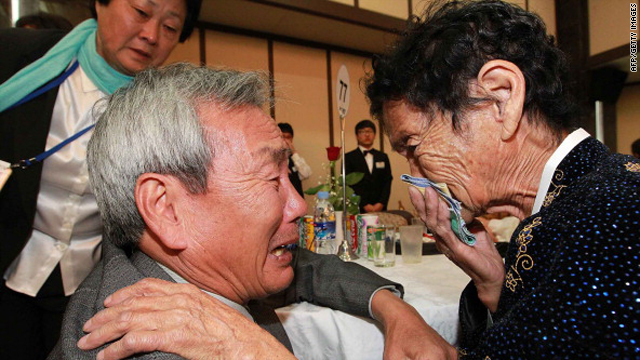 North Korean Kim Ho-Sook, right, 83, meets her South Korean brother Kim Ho-Dae during a family reunion after being separated for 60 years on Saturday in Mount Kumgang, North Korea. Credit: Andrew Salmon, CNN |
 |
A North Korean man (right) on a bus waves his hand as a South Korean man weeps after a luncheon meeting during inter-Korean temporary family reunions at Mount Kumgang resort October 31, 2010.
Credit: Kim Ho-Young / Reuters
|
 North Korea's Chung Duck-Hwa (R) embraces Chung Myung-Hoi - her long-separated sister from South Korea - during a family reunion in Pyongyang, on August 15, 2000. Credit: File photo: AFP |
 |
| South Korean Park Yang-Gon (L) meets with his North Korean brother Park Yang-Soo. No contact for decades. Credit: Paula Hancocks, K.J. Kwon and Madison Park, CNN. |
 |
South Korean Kim Sa-Moon (left) meets with her North Korean older sister Kim Tae-Un, 78, during a family reunion after being separated for 60 years on Feb. 23 in Mount Kumgang, North Korea. Photo by Yoon Dong-Ju-Korea Pool/Getty Images. |
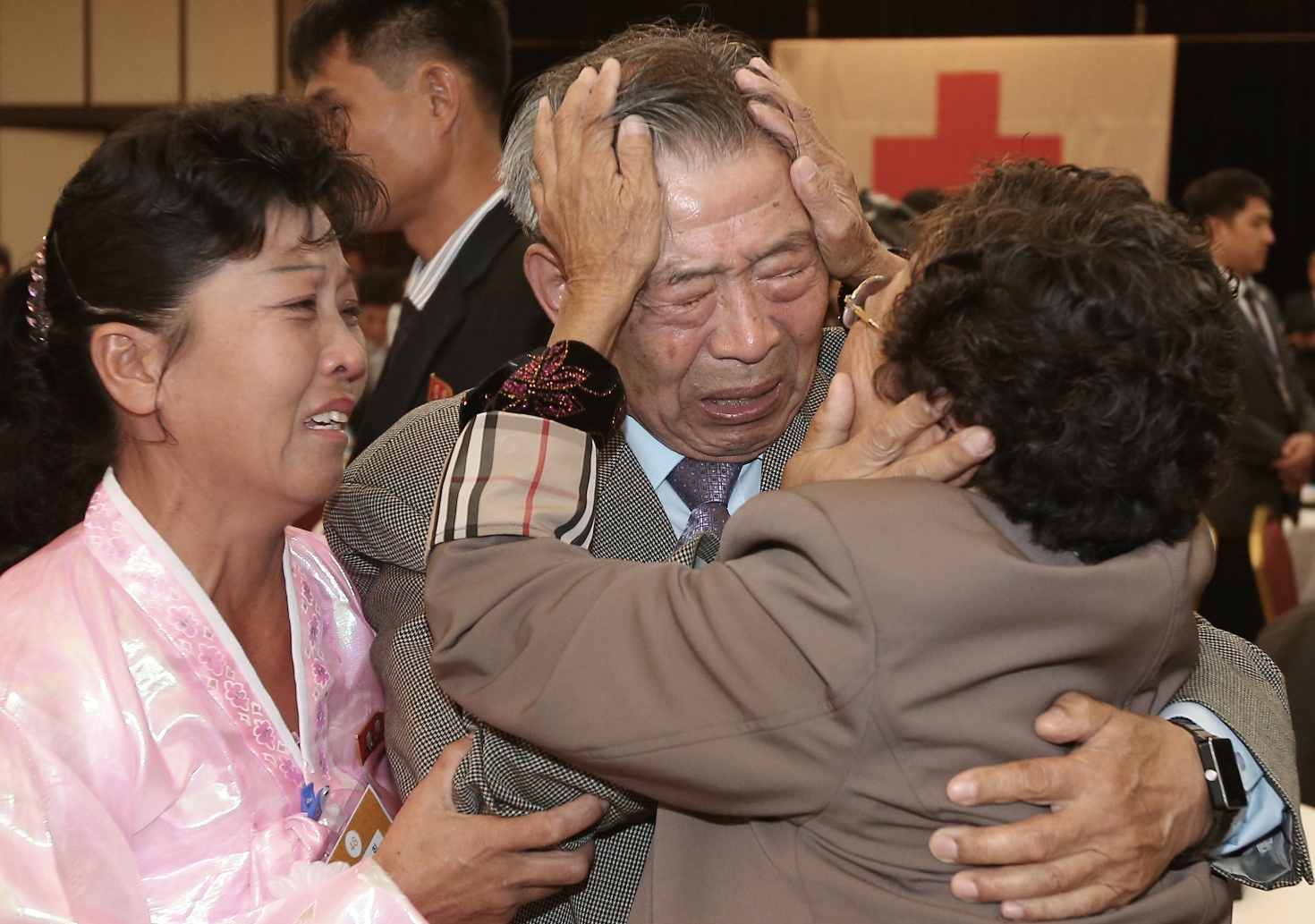 South Korean Min Ho-shik, 84, center, hugs his North Korean family member Min Un Sik, right, during the Separated Family Reunion Meeting at Diamond Mountain resort in North Korea, Tuesday, Oct. 20, 2015. Hundreds of elderly Koreans from divided North and South began three days of reunions Tuesday with loved ones many have had no contact with since the war between the countries more than 60 years ago. At left is an unidentified family member of North Korean Min. Credit: Kim Do-hoon/Yonhap via AP. |
Subscribe to:
Posts (Atom)